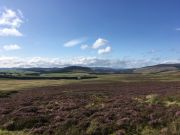
Glenlivet Estate - Banner showing the rolling hills on the Glenlivet Estate. The typeface is a classic style stating Glenlivet Estate and the crown Estate Logo is top left linking to the CE website
     
  Home · Access information · Walks, trails & outdoor activities · Publications · Places of interest · Accommodation · Wildlife · Estate management · How to get here · Educational visits & resources · Photo library · Ranger services & guided walks · Access for all · Links · Activities, crafts & local info · History · Geology & physical characteristics · News  
     
spacer
   
spacer
  spacer   spacer spacer  

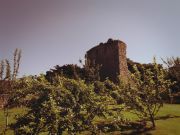
Drumin Castle

Bigger text

Smaller text

Help Page

Home Page


HISTORY - BATTLE OF GLENLIVET & BRAES OF GLENLIVET

THE BATTLE OF GLENLIVET

In 1594 a force of about 2000 local men in support of the Catholic Earls of Errol and Huntly routed 10,000 highlanders under the Protestant Earl of Argyll at the Battle of Glenlivet. A dramatic event with deep and complex roots, the battle represented a victory of artillery and horse over irregular infantry and has passed into local legend. The site of the battle can be reached via Walk 4 from Allanreid, or from the Forestry Commission car park at Morinsh on the B9009. The walk through the forest is well sheltered and enjoyable providing some attractive views. To commemorate the 400th anniversary of the conflict, Sir Edward Peck (a local historian) produced a detailed history of the battle in a small booklet. This is available at the Tomintoul Tourist Information Centre and local shops

BRAES OF GLENLIVET

Close to Tomnavoulin, is the small hamlet of Auchnarrow. Here a road known locally as the ‘ Braes Road ’ takes you to Chapelton and the Braes of Glenlivet. The road skirts around the base of a prominent isolated hill which lies ahead, into the heart of the secluded ‘Braes’. This rounded hill is the Bochel - a name derived from the Gaelic ‘buachaille’ meaning ‘shepherd’ or ‘guardian’ - and you can see how it would have got its name, dominantly situated as it is, at the entrance to the Braes from the north. In the heart of the Braes, 1 km beyond where the tarmac ends lies the ‘forbidden’ college of Scalan , arguably one of the most significant sites of historical interest in the area.

“In the dark penal days of that by-gone time,

When our catholic faith was condemned as a crime

The great Duke of Gordon, so generous and brave-

To the Bishops,a site for a college he gave

 -

And Scalan, remote in a wild Highland glen,

Surrounded by mountains, morasses and fen

Was adjudged most secure, whilst possessing some charms

Where students might work and pray safe from all harms”

-

This seclusion, which the Braes of Glenlivet offered to persecuted 18th Century Catholics, is well appreciated as you journey into this remote and isolated part of Glenlivet. If ‘The Braes’ seem remote today, it is easily imagined how cut off this area was hundreds of years ago, and it was this isolation, which from 1717-1799, allowed Catholics to maintain a foot-hold in these far away hills, despite repeated attempts to extinguish the faith during these troubled times.

The old College of Scalan , (named after the Gaelic sgalan, meaning turf roof), was built then as a seminary to train young students in the ways of the Priesthood. It lies about 1km from the car park at Eskemulloch, along the rough farm track which heads towards the wood. The track is rough in places and it is not advisable to take cars along it - not least because the atmosphere of the Scalan is spoiled by the intrusion of modern vehicles. The building is open all year for visitors to savour how ‘with courage and dogged perseverance’ the Catholic faith survived and a detour to explore the area is thoroughly recommended.

Despite repeated attacks from Hanoverian soldiers throughout the 18th century, which resulted in the complete destruction of the college in 1746 after the battle of Culloden, it survived as the seat of Catholic teaching in Scotland, until the pressure of persecution was relaxed during the Napoleonic wars. The foundations of the original building can still be seen near the bridge across the burn, and just below, the Bishops well - which supplied the college with fresh water - is tucked into the bank beside the burn ‑ a welcome source of clear spring water on a hot summer’s day.

Each time the college was attacked the students and their instructors escaped to the hills only to return once the coast was clear, to make repairs and restart their studies - which as you might expect were character building to say the least....

“The students came from the pockets of Catholic population in the North East, but also from as far away as Edinburgh and the West Highlands . Their life was Spartan in the extreme. They would study, pray and eat in one room and sleep in the room above. Rising at 6am the students washed in the Crombie, then, dressed in black and blue tartan, they had a frugal breakfast of oatmeal porridge and began their rigorous day. They managed to have meat two or three times a week, and supper was again the inevitable porridge, although it must be mentioned that this meagre diet was typical of that time and place. In 1722 a set of rules was drawn up for the students, the essence of which was prayer, study, plenty of fresh air and exercise and importantly, they were told not to talk to strangers!”

The walk to the Scalan forms part of a waymarked route called the Braes Heritage Trail and a small booklet describing the walk- ‘Water of Life and a Breath of Fresh Air’- is available. The book is based on information gathered from long standing residents of the Braes, who describe the landscape and its history through their own eyes. The walk takes you to a prominent viewpoint which offers a magnificent outlook over the Braes to the east and the Cairngorms to the west, and if you wish it can be linked up with an old path over the hills to the Well of the Lecht, once a `whisky road' used by smugglers, for while the Braes once provided seclusion for religious exiles, at the same time it’s isolation certainly proved an advantage for the notorious ‘Peetreeker’s’ !

A smuggler - not a real one!
A whisky smuggler

Glenlivet welcomes you to explore its tracks and byways.

   
History of Glenlivet Introduction
Tomintoul
Campdalmore
Bridge of Avon
Battle of Cromdale
Kirkmichael
Balcorach
Drumin Castle
The Packhorse Bridge
Glenlivet Distillery
Scalan and Braes of Glenlivet
Battle of Glenlivet
Whisky Smuggling
The Lecht
           
spacer
   
spacer
Glenlivet Estate - Banner showing beautifully marked stones, the Glenlivet Estate in typeface classic and the crown Estate Logo - click the Logo to go to the Crown Estate web site