Glenlivet Estate - Banner showing the rolling hills on the Glenlivet Estate. The typeface is a classic style stating Glenlivet Estate and the crown Estate Logo is top left linking to the CE website
     
  Home · Access information · Walks, trails & outdoor activities · Publications · Places of interest · Accommodation · Wildlife · Estate management · How to get here · Educational visits & resources · Photo library · Ranger services & guided walks · Access for all · Links · Activities, crafts & local info · History · Geology & physical characteristics · News  
     
spacer
   
spacer
  spacer   spacer spacer  

Braes in the mist with a column of chimney smoke drifting upwards

Bigger text

Smaller text

Help Page

Home Page

Download Adobe Acrobat Reader


Geology and Physical Characteristics

PRESENT DAY GEOLOGY
The hills of Glenlivet and the Highlands we see today are not the direct product of the Caledonian period since the old mountain chain was eroded away and their foundations covered by later strata. Uplifted once more to a fraction of their former height, these hard metamorphic foundations have now been exposed by the removal of their sedimentary blanket, to form the Highlands. Erosion of the Caledonian mountains produced sediments now represented by the Old Red Sandstone strata. These in turn were partly covered by later sediments some of which are of marine origin, laid down when the land was depressed below sea level.

During the latter part of the Tertiary period about 26 million years ago when new crustal movements were creating the Alps, the land area of what is now the Highlands was uplifted. Previously reduced to a near sea-level plain, it rose as a solid block without folding, in a series of successional steps. The sediments, which had accumulated over the ancient schists were gradually removed by erosion, to reveal the old Caledonian mountain roots. Being harder, these rocks resisted erosion and it is these schists, quartzites and the hard igneous granite intruded into the schists during the Caledonian orogeny, that form the Grampian Highlands, of which the Cairngorms, the neighbouring Ladder and Cromdale hills and Glenlivet Estate are a part. The Cromdale hills are formed mainly of Moinian granulites, but are capped along their summits by a layer of Dalradian schist, which forms a series of bands in the Moine. The junction between the Moine and Dalradian rocks runs north-east to south-west through the estate roughly following a straight line from the Glenlivet Distillery to the Bridge of Brown. The Moine outcrops to the north-west of this line and the Dalradian to the south-east. The river Avon crosses this boundary as it makes a detour around Cnoc Fergan (GR NJ 147234).

Thus, most of the Glenlivet Estate is underlain by Dalradian rocks - dominantly quartzites, black schists (with various quartzite and limestone bands) and pelite (shale). Old Red Sandstone overlies these metamorphic rocks in the central part of the estate between Tomintoul and Tomnavoulin, extending across the Feith Musach, into the Braes of Glenlivet and up towards the Lecht almost as far as the mine.

The basin of the river Livet and its tributaries from Alanreid to the Suie and up the Blye water to Ladderfoot, is underlain by the only area of granite to be found on the Estate. The Ladder hills are entirely composed of Dalradian rocks including hard, resistant quartzites at lower levels, topped by pelite which forms the summit ridge. Small amounts of black schist and semi-pelite (with calcareous and quartzite bands) occur in the vicinity of the Lecht mine.

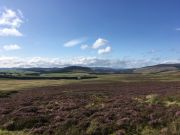
Hills on the Glenlivet Estate
Walking on geology

Glenlivet welcomes you to explore its tracks and byways.

   
Introduction
Rock types through the ages
Present Day Geology
The Landscape
Woodlands
 
Geology Document pdf document logo
           
spacer
   
spacer
Glenlivet Estate - Banner showing beautifully marked stones, the Glenlivet Estate in typeface classic and the crown Estate Logo - click the Logo to go to the Crown Estate web site