Geology and Physical Characteristics
Rock types through the Ages
The Moine Schists
The Moine schists (named after their occurrence at A'Mhoine in Sutherland), are a succession of metamorphosed sandstones of Precambrian origin, which were formed about 740 mya. Sediments washed into the sea from the ancient gneiss landscape which lay to the north of what is now Britain, were consolidated to form sandstones. These rocks were later metamorphosed to form schists with a crystalline structure which mimics the original grains of sediment. They are relatively hard rocks with a grey, buff or pink colouring, and commonly have a layered appearance like the original depositional bedding. This layering is partly the original bedding reduplicated by tight folds, and partly a banding or striping of newly-developed metamorphic minerals. The two together give a parallel structure or foliation to the rocks, which are called `Psammitic granulites'. Geologically, they are fairly uniform and create a relatively monotonous scenery.
The Dalradian Rocks
These younger schists are much more varied and were formed from a variety of sedimentary rocks which included siliceous sandstones, shales, carbonaceous mudstones, calcareous mudstones and limestones, which are now represented by quartzites, mica-schists, black-schists, calcareous schists and marble respectively.The original Dalradian sediments (named after the first Scots kingdom of Dalradia), are thought to have been laid down during the Cambrian period (570 - 500 mya).Crustal movements had previously folded and up-lifted the Moine schists into a huge mountain range which over hundreds of millions of years had been eroded away, partly exposing the ancient gneiss. A downwarping of the crust allowed a Cambrian sea to cover much of the area which is now Britain. Sediments eroded from the old gneiss continent to the north were deposited in this marine environment of current swept shallow waters, sandy shoals, calcareous lagoons and local deeps with muddy floors. It was these sediments that were later to form the Dalradian rocks.
The Caledonian Orogeny
At the end of the Cambrian, and the start of the Ordovician (500 mya) tectonic movements caused a massive mountain building period - the Caledonian orogeny - which lasted 130 million years. It was during this period of intense tectonic activity that the sea floor mud and sand became metamorphosed into the Dalradian crystalline schists and quartzites that we see today. They and the underlying Moine rocks were raised in a mountain range of Himalayan proportions. Magma from under the crust burst through to the upper rocks and crystallized slowly to form granite. The formerly flat beds of schist were intensely contorted and heaved into huge overfolds, so much so that the junction between them became extremely distorted. It was the horizontal pressure generated from the east-south-east direction during this orogeny which is now reflected in the series of folds which give the Highlands their north-east to south-west alignment.
Old Red Sandstone
The Caledonian range on its rising was not clothed by vegetation as no plants had evolved in high enough form to invade the land at that time. During this Ordovician period, Scotland lay near the equator. The bare mountains were quickly eroded by rain and floods, depositing sands in basins, estuaries and shallow seas. These sediments, which accumulated to huge depths, eventually consolidated to form Old Red Sandstone lying on top of the older Moinian and Dalradian schists.

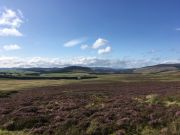
Heather in bloom
Glenlivet welcomes you to explore its tracks and byways. |