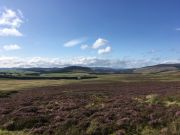
Glenlivet Estate - Banner showing the rolling hills on the Glenlivet Estate. The typeface is a classic style stating Glenlivet Estate and the crown Estate Logo is top left linking to the CE website
     
  Home · Access information · Walks, trails & outdoor activities · Publications · Places of interest · Accommodation · Wildlife · Estate management · How to get here · Educational visits & resources · Photo library · Ranger services & guided walks · Access for all · Links · Activities, crafts & local info · History · Geology & physical characteristics · News  
     
spacer
   
spacer
  spacer   spacer spacer  

Mountain hare

Bigger text

Smaller text

Help Page

Home Page


Wildlife & Sites of Special Scientific Interest (SSSI)

Glenlivet Estate - Natural History and Sites of Special Wildlife Interest

The location of the estate at the edge of the north eastern Cairngorms and the combination of managed and open countryside creates a varied, diverse landscape, which exhibits a wide range of upland habitats. This diversity combined with the variation from low lying woodlands and rivers through to hill top vegetation, means that the estate supports a wide variety of wildlife and has several sites which are important for their natural interest.

red squirrel
Red Squirrel

The principal habitats which are of interest include:

  • Ancient semi-natural birch and alder woodlands.
  • Scrub (especially sub-montane Juniper scrub)
  • Extensive heather moorlands
  • Raised peatland and bog
  • Montane heath
  • Unimproved lowland meadows
  • Rough grassland
  • Largely unmodified rivers and river banks
  • Farmland and conifer plantations

If you are interested in finding our more about the natural heritage on the Estate, guided walks are organised by the Estate Ranger Service during July and August each year (link to Ranger Service page). Alternatively further information about the area’s wildlife is available and guided tours can be arranged through Glenlivet Wildlife. (link to www.glenlivetwildlife.co.uk )

Birds and Animals
The combination of rivers, woodland and open ground, creates conditions suitable for many typical upland species of birds and animals, some of which (particularly birds of prey) are relatively rare. Around 60 species of birds breed or are resident in the area, and a further 40 or so species of winter/summer visitors and migrants, can be seen at different times of the year.

The range of wild mammals found on the estate is also highly diverse, and includes species such as the wildcat and pine marten. While no areas of ancient pinewood survive in the area, the moorlands, conifer plantations and broadleaved woodlands provide habitat for many typical upland species including roe and red deer, badger, fox, bats and red squirrel - all of which are relatively common.

The Estate supports over 100 UK Biodiversity Action Plan species including at least 23 'Priority Species of conservation concern.’

Priority Species known to be present on the Estate:

Mammals (4): Pipestrelle bat, Red squirrel, Brown hare, Otter

Birds (9): Skylark, Grey partridge, Capercaillie, Song thrush, Black grouse, Spotted flycatcher, Linnet, Bullfinch, Reed bunting

Invertebrates (5): Pearl bordered fritillary, Northern brown argus, Netted mountain moth, Northern dart moth, Freshwater pearl mussel

Vascular Plants (1): Juniper

Lower plants (3): Alpine sulphur tresses (a lichen), Dickies bladder fern, Aspen bracket fungus

Statutory Natural Heritage Designations

Lying at the edge of the Cairngorm massif, the majority of the Estate lies within the Cairngorms National Park. It is also designated as being of Great Landscape Value and is part of the Cairngorms Straths Environmentally Sensitive Area. In conservation terms, the main statutory provisions on the estate, concern areas which have been designated as Sites of Special Scientific Interest (SSSI) because of their wildlife value.

Sites of Special Scientific Interest (SSSI’s)
There are five SSSI’s within the estate and these include one area of moorland, three semi-natural woodland sites and one unimproved wetland meadow site. The sites are representative of the wider natural heritage interest found in the area. One of these sites (Creag nan Gamhainn) has been included on the list of Special Areas of Conservation sites (SAC’s) under the European Habitat’s Directive, and another (the Ladder Hills) is a proposed Special Protection Area (SPA) for its Hen Harrier population.

SITES:

  1. Ladder Hills
  2. Lower Strathavon
  3. Bochel Wood
  4. Creag nan
  5. Fodderletter

roe deer calf
Roe Deer calf

Glenlivet welcomes you to explore its tracks and byways.

   
The Sites of Special Scientific Interest are :-
Checklists in PDF format
Bird List (.pdf)
Flowering Plants (.pdf)
Mammals (.pdf)
 
Species Distribution Maps
 
Wildlife Tours of Glenlivet - Glenlivet Wildlife


spacer
   
spacer
Glenlivet Estate - Banner showing beautifully marked stones, the Glenlivet Estate in typeface classic and the crown Estate Logo - click the Logo to go to the Crown Estate web site