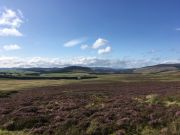
Glenlivet Estate - Banner showing the rolling hills on the Glenlivet Estate. The typeface is a classic style stating Glenlivet Estate and the crown Estate Logo is top left linking to the CE website
     
  Home · Access information · Walks, trails & outdoor activities · Publications · Places of interest · Accommodation · Wildlife · Estate management · How to get here · Educational visits & resources · Photo library · Ranger services & guided walks · Access for all · Links · Activities, crafts & local info · History · Geology & physical characteristics · News  
     
spacer
   
spacer
  spacer   spacer spacer  

Braes in the mist with a column of chimney smoke drifting upwards

Bigger text

Smaller text

Help Page

Home Page

Home Page

Download Adobe Acrobat Reader


SEMI-NATURAL WOODLANDS ON GLENLIVET ESTATE

The Value of Semi-Natural Woodlands for Nature Conservation

Prior to man's influence, woodlands were the most extensive natural habitat in Britain and the great majority of our wildlife is adapted to and relies on woodland conditions for germination and growth, feeding, breeding, cover or shelter. Native woodlands were extremely complex in structure and composition with a wide variety of tree species in the canopy and understorey, a shrub layer, a rich ground and litter layer, dead and dying trees, glades etc. These would vary with the ground conditions and other environmental factors, each component providing a series of niches for a diverse community of flowering plants, mosses, fungi, ferns, birds, mammals, etc.

It is doubtful whether any woodlands in Britain are now totally "natural", all having been modified to some degree by man. However, semi-natural woods have, in general, been modified to a lesser degree and most closely resemble the native woodland cover of Britain. Semi-natural woods are those which are composed predominantly of species native to the site and which have become established by natural processes, their distribution reflecting the variation in conditions within the site. The other main category of woodlands is plantations. These are generally much more influenced by man and more intensively managed. They are often composed of fewer tree species (including non-native species), are even-aged and structurally simple, and involve modification of natural ground conditions. Many woodlands species are also absent since they are slow at colonising new sites. The overall woodland community is therefore usually much more limited and dominated by a few adaptable or mobile species. Another important different is that plantation communities are recreatable whilst those of semi-natural woods, once lost, cannot be recreated except in the very long term.

In addition to their origin, two other factors are important in determining the relative value of a wood for nature conservation - the history of woodland cover and its management.

All other factors being equal, the longer a site has been under continuous woodland cover, the richer the wildlife community which occurs there. This applies to both semi-natural and plantation woods and has lead NCC to prepare its Ancient Woodland Inventories such as the one for Moray. In this, woodland sites are classified as ancient (i.e. shown on maps from c1770, c1850 and c1880), long-established (i.e. shown on maps from c1850 and c1880) or other (shown on maps from c1880 but not c1850). The identification of ancient and long-established semi-natural woods (and some long-established plantations of native species on former woodland sites) has proved useful in highlighting those sites which have greatest potential for nature conservation.

Although the canopy composition of a wood and the history of woodland cover can be good indicators of a site's value, the impact of management (particularly grazing by livestock) can be decisive. Prolonged heavy grazing can prevent regeneration, thereby opening up the wood and simplifying its structure, and drastically modify the ground flora. If practised over a long period it will inevitably destroy a woodland and create a relatively species-poor pasture dominated by grasses. The value of many semi-natural woods often depends on how far along this process of degradation it has reached.

The Extent and Composition of Semi-Natural Woodlands on Glenlivet Estate

Woodlands on Glenlivet Estate probably reached their maximum post glacial extent some 7000 years ago when all but the high tops of the Ladder and Cromdale Hills were wooded. This native woodland cover has been progressively depleted by clearance, grazing and possibly climatic change. Some 550 ha of native woodland is currently present on the estate. The great majority on the steeper or less well drained ground along the main river valleys. (It should also be pointed out that many smaller groups of trees or linear strips along riverbanks or field boundaries have not been identified but nevertheless form an important component of the woodlands on the Estate).

The majority of semi-natural woods on the Estate are now largely composed of birch with frequent rowan. These are commonly associated with the humus iron podsols of the valley slopes. Where only lightly grazed, the ground flora of these woods is dominated by blaeberry and cowberry with heather, bush vetch, wood anemone, violets, chickweed wintergreen, hard fern, oak fern, etc and there is often a good shrub layer of juniper (e.g. Bochel, Craggan, Cnoc Fergan). In some areas birch and eared willow occur on gleyed peats with a ground layer of Molinia grass, heather, bog myrtle etc (e.g. Bochel, Ballantruan).

Birch woodland also occurs on well drained brown forest soils and fluvioglacial deposits (e.g. Creag nan Gamhainn, Doune, Strathavon Lodge). These are less extensive and are often indicated by the presence of hazel and a ground vegetation of soft grasses, Dryopteris ferns, bracken, wood sorrel, greater stitchwort, primrose etc. On the limestone of Creag nan Gamhainn the flora is very rich indeed with several local and national rarities.

The other common tree species is alder which is dominant on the alluvial soils and gravels of the river flood plains and the gleyed soils below springlines on the valley sides. Bird cherry is also abundant in these areas and birch remains a frequent component. The ungrazed ground vegetation consists of extensive dog's mercury and greater woodrush with meadowsweet, angelica, nipplewort, bugle, golden saxifrage, wood avens, yellow pimpernel, etc.

The only other widespread native tree is aspen which occurs as distinct clones amongst many birchwoods. Ash, wych elm, gean and goat willow are confined to a few flushed brown forest soils in the lower reaches of the Avon and Livet, often on steep burnsides. Oak is also scarce (the nearest large stand being at Shenval opposite Doune) but may have been more frequent in the past amongst sheltered birch/hazel woods. Whilst oak may have been selectively felled in the past, it is also possible that the local climate may have limited its abundance in these upper glens.

The almost complete absence of Scots pine (outside plantations) is striking since it is likely that large areas of peaty podsols above the main valleys supported native pine woodland in the past. Such woodland, comprising pine, birch and juniper, still exists at nearby Abernethy. Scots pine was probably also a component of acid birch woodland on the valley sides but the nearest native remnant is in Upper Glen Avon. Self sown Scots pine does exist on several moorland areas on Glenlivet and on some river shingles but these are all thought to derive from seed from plantations.

The NE of Scotland is noteworthy for the abundance of juniper and Glenlivet is no exception. As well as being a frequent component of most birchwoods it occurs in many other semi-natural habitats, often as a relict of past woodland cover. Juniper scrub is also an important habitat in its own right and was probably characteristic of glades in former native pine woodland and the exposed upper margins of woodland cover. Examples of this submontane juniper scrub are now scarce in Britain but several remain on Glenlivet Estate (e.g. Feith Musach, Alltach Beag, Well of Lecht etc.)

Other native shrubs are scarce on Glenlivet Estate. Hawthorn, sloe and elder occur in a few lowground sites (often near farms) and blackcurrant is found in a few alderwoods. Dog rose, broom and whins are however common, especially in disturbed areas.

There are very few policy or ornamental plantations on the Estate but some larch, ornamental conifers, beech, lime, sweet chestnut etc have been planted near large houses and villages, e.g. Kylnadrochit, Drumin, Auchbreck and Bridgend of Glenlivet. Some native species such as gean and wych elm have also been planted as have hawthorn hedges at Nevie. The most widespread introduced broadleaf is sycamore which has been planted around many farms for shelter. Sycamore has spread to several riverside woods but is not common except in a few woods near the foot of the Livet where there is abundant regeneration. Other introduced plants which are particularly invasive in some Scottish woods are very localised on the Estate (e.g. rhododendron, snowberry, leopardsbane).

Birch woods
Birch woods

Glenlivet welcomes you to explore its tracks and byways.

   
Introduction
Rock types through the ages
Present Day Geology
The Landscape
Woodlands
 
Geology Document pdf document logo
           
spacer
   
spacer
Glenlivet Estate - Banner showing beautifully marked stones, the Glenlivet Estate in typeface classic and the crown Estate Logo - click the Logo to go to the Crown Estate web site